
Apeiron’s PvP Development
October 2023 - April 2024
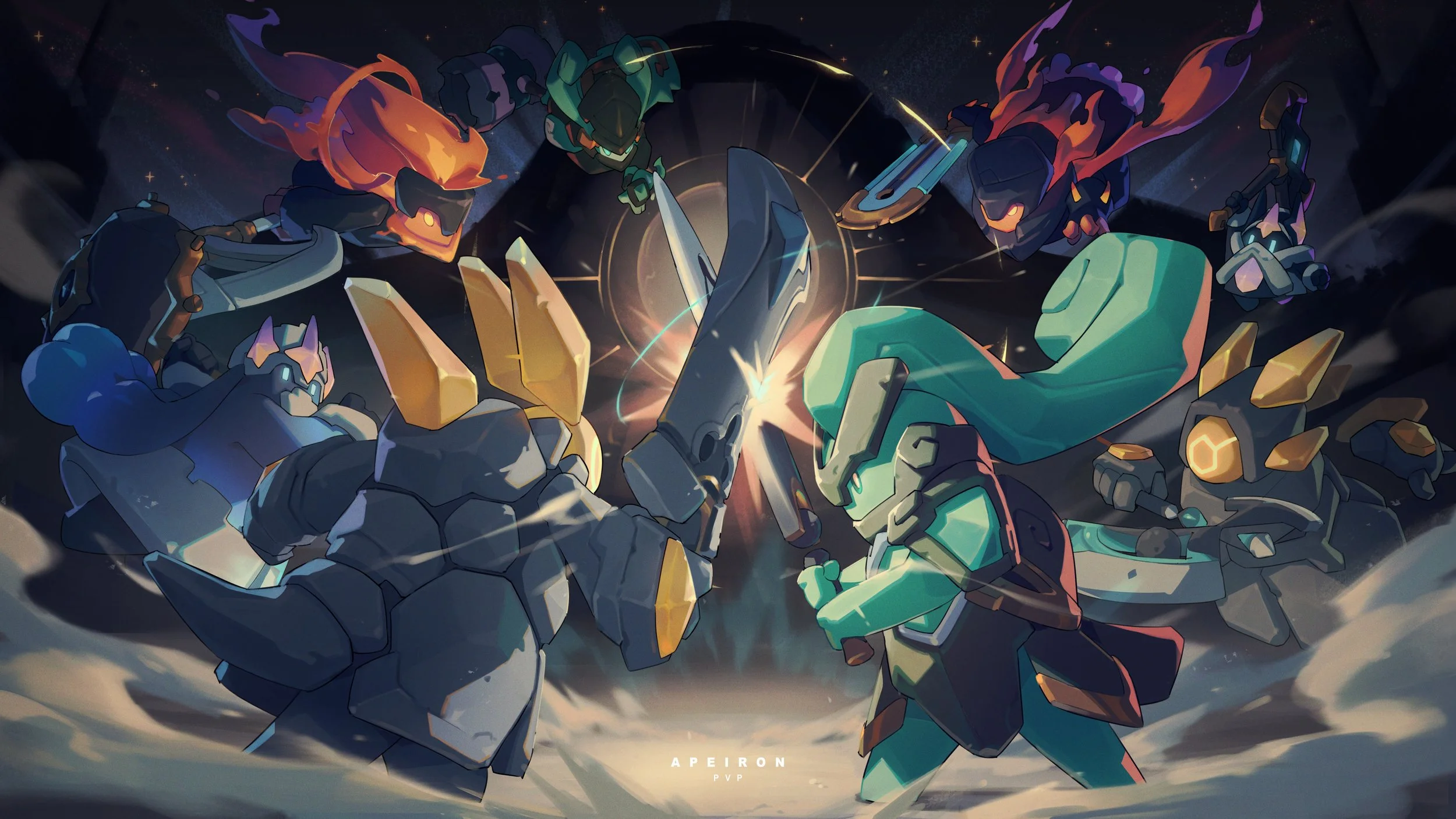
A design case study documenting my role in transforming Apeiron from a PvE dungeon crawler into a competitive PvP arena. The study combines written analysis and gameplay highlights to showcase how the design evolved from concept to live implementation. Developed during my time at Foonie Magus, Hong Kong.
ABSTRACT
This paper analyzes the transformation of Apeiron from a slow-paced, low-agency roguelite PvE dungeon crawler into a fast-paced, skill-driven PvP experience designed for competitive play. The goal was to revamp the pacing, responsiveness, and ability design originally intended for PvE encounters and reimagine them for an esports-ready competitive environment. Through systematic testing, analysis, and rebalancing of over one hundred unique abilities and attributes, the project identified and resolved underlying design constraints that limited player expression while redefining how the game was perceived by its player base. Collaboration with the PvP producer and technical designers ensured that proposed changes were both feasible and aligned with the broader vision for the title. The result was a restructured combat system that achieved the fluidity and agency needed to captivate players - creating a mode that was rewarding to learn, offered a high skill ceiling for mastery, and attracted over 70,000 participants during its first open season.
PvE Dungeon Crawler to PvP Arena Battler
Developed by Hong Kong studio Foonie Magus, Apeiron is a real-time card-battling game that originally featured a roguelite PvE dungeon crawler as its main gameplay mode. While a 1v1 competitive PvP system had always been part of the studio’s long-term goal, the game’s combat framework was fundamentally built for PvE, which was defined by predictable enemy behavior, linear power scaling, and step-by-step battle progression. These systems were effective for dungeon encounters but translated poorly into a PvP environment, producing a mode that felt unnaturally linear.
To understand Apeiron’s PvP challenges and the changes made in response, there are a few key terms that need to be explained:
Avatars - The player's primary controllable character. Each Avatar has a unique composition of elemental points, earth/water/fire/air, summing to 100. Higher concentration in individual elements allows players to access abilities that are higher tier per element.
Apostles - Companions that join players in battle. There are six classes (Hunter, Guardian, Warrior, Mage, Rogue, Priest), with each class having eight unique skills. Every Apostle is equipped with three random skills, meaning players adapt their playstyle depending on what skills their Apostles have. Players bring 4 apostles into battle with them each match.
Abilities - Abilities are special moves that Avatars and Apostles can perform. These deal damage, heal, shield, displace, crowd control, debuff, and buff other units on the battlefield. Avatars can equip 3 skills of their choice depending on what skills they have access to, whereas Apostles are born with 3 random skills. In battle, each player has a total of 15 abilities (3 from the Avatar, and 3 per Apostle). Players have access to 4 random abilities at all times - casting any ability replaces it with another random one from the total pool.
Mana - Mana is the resource used by players to cast abilities. Each player regenerates 0.5 mana per second, and can have up to 10 mana at once. Abilities cost between 1 and 7 mana.
Early testing in PvP revealed a core issue: player skill could not reliably translate into impact. Even when skill levels differed significantly, matches often felt like coin tosses - decided not by execution, but by who drew their strongest ability first. Showcased below is Index 1, the first recorded highlight in PvP testing dated mid October 2023, and it helps better paint a picture of what gameplay looked like at the start. Although the satisfaction of chaining multiple area-of-effect skills makes this clip memorable, it also highlights an underlying issue: both players’ units are clustered together, racing to cast their strong abilities first, but the player who was able to cast theirs first won. This victory was more of a result from RNG than skill, and the feedback players provided often spoke on this issue.
Research in game psychology has shown that a player’s motivation to play is driven by their ability to effectively influence outcomes (Przybylski et al., 2010). When victory depends more on factors outside a player’s control than on actual mastery, the incentive to improve disappears. In the current state of the game, a player could both make smarter decisions and execute their actions more skillfully than their opponents, yet still end up losing. At its core, Apeiron’s PvE systems did not support the high-agency gameplay required for a truly competitive experience, and the balance and design changes needed to ensure this issue was dealt with as soon as possible. In order to do this, the first step was figuring out where the PvE systems fell short in a PvP environment.
Index 1: Gameplay Highlight, October 2023
PROBLEM 1: Setting the Pace
The game’s pace of combat had difficulty enabling reactive and exciting competitive play. Low mana regeneration, for example, often led to long cycles of evasion as both players waited for mana to recover before engaging. Additionally, long dash cooldowns made mistakes feel overly punishing, and the low base movement speed made regular movement feel almost like standing still. These factors led to gameplay feeling one-dimensional, focused on waiting for resources rather than actively outmaneuvering opponents, making the game appear closer to an autobattler than the target of a competitive fast paced 1v1.
Once pacing was identified as one of the core issues, the next step was to redefine what the game’s tempo should feel like. The goal was to create consistent engagement, where players always felt in control of the match’s rhythm. It’s important to keep in mind that this wasn’t necessarily to create a loop of nonstop action, but instead to ensure that players consistently had opportunities to meaningfully interact with their opponents.
To accomplish this changes were made to both baseline mobility and resource accessibility:
Baseline Mobility: Player movement speed was doubled, allowing dodging without relying solely on dashes. Dash cooldowns were halved to make movement feel more fluid and reduce how punishing mistakes felt.
Resource Accessibility: Mana regeneration was increased by 40%, and total mana pools were expanded by 50%. The regen increase targeted prolonged downtimes, while the larger pool encouraged more strategic decisions between constant casting and saving for high-cost combos.
These adjustments made to mobility and mana increased the pace of the game significantly by giving players consistent access to more tools for outplaying their opponents in both offensive and defensive situations. Index 2, a gameplay highlight from early November 2023, perfectly demonstrates this in action: a player on the edge of defeat dodges an incoming ability at the last second, then counters with their own to secure victory. As intended, skill expression through outmaneuvering opponents became more commonplace, and strategically using abilities for counterplay became much more feasible now that players had more mana to spend. The increase in mana, however, shined a light on another issue with the PvE’s system in PvP, ability fluidity.
Index 2: Gameplay Highlight, Early November 2023
PROBLEM 2: A Fluid Gameplay Experience
High cast times, long animation lockouts, and lack of movement while casting made sense for PvE dungeon encounters where recognizing windows of opportunity for attack is expected, and getting punished for mistiming is a necessity. In PvP, however, these three ability attributes led to gameplay that felt incredibly unresponsive. In a competitive PvP setting, abilities are usually used in response to what is happening in the moment. Instead, there was a clear disconnect between what players wanted to do and what happened in-game. Even though standardized cast times looked balanced on paper, this ended up disproportionally affecting each ability, making balance incredibly difficult to attain. Abilities would have low win rates not because of value errors, but instead because of use case functionality, which numbers on their own could never explain. Shielding abilities were one of the clearest examples that showcased how win rates alone could never show this problem of use case functionality:
Shields are meant to block incoming damage, but long cast times often made that impossible. This issue flipped the intended counterplay dynamic: instead of using shields in response to threats, players resorted to using them at random, hoping they would absorb some damage from their opponents. Consequently, shielding abilities had low win rates, and increasing the shield value had little impact on helping this.
A rework to cast times, animation lockouts, and movement while casting was necessary, but to properly reframe the system, each ability had to first be categorized as reactive, combo, or stand alone:
Reactive abilities: Primarily shielding, healing, and movement related abilities. Cast times were lowered significantly or removed entirely to better enable their reactive use-cases.
Combo abilities: Defined as crowd control, enemy debuffs, and ally buffs. Cast times were trimmed only slightly to preserve counterplay, but animation lockouts were reduced or removed entirely so these abilities could chain cleanly to support combo potential.
Stand alone abilities: Abilities effective without depending on any setup or follow up. Cast times and lockouts were reduced case by case. Movement while casting was added to abilities with lower impact or high precision requirements to make them feel responsive without overpowering them.
With cast times, animation locks, and movement restrictions now tailored individually to each ability’s design, players could finally use their skills the way they intended, and the viewing experience became noticeably more exciting. Index 3 marks the first gameplay highlight that truly made viewers say, “what just happened?” Despite a camera tracking bug, the outplay is unmistakable: the player dives in, predicts their opponent’s movement, and escapes at the last second with a sliver of health to secure victory. Gameplay was now capable of producing exciting, skill-expressive moments, and players started experimenting with the newly adjusted abilities. However, some abilities were still dominating in almost every situation, revealing a deeper issue with the game’s numerical balance.
Index 3: Gameplay Highlight, Late November 2023
PROBLEM 3: Leveling the Playing Field
The game’s original balance model followed a strict hierarchy: higher-tier Avatar abilities were always stronger than lower-tier ones, and Avatar abilities in general outclassed Apostle abilities. “Stronger” didn’t necessarily mean higher impact - it also meant better mana efficiency and overall value. This worked fine in PvE, where players unlocked stronger abilities as they progressed. But in PvP, players couldn’t learn new abilities. Their access was tied to the Avatars they owned, meaning players without high-tier abilities could rarely compete, no matter their mechanical skill.
The issue wasn’t that harder-to-access abilities were stronger, but that access alone often decided the outcome of a match. Victory was too dependent on what abilities a player had, rather than how well they played. This made matches feel predetermined rather than tests of skill and strategy, discouraging new players from wanting to continue playing. On top of that, because high-tier abilities were so much more efficient and impactful, most strategies revolved around burning through lower-tier abilities as fast as possible, then relying entirely on the strongest one.
To address this, the redesign shifted toward a more horizontal balance model aimed at narrowing the power gap between abilities. The goal wasn’t to make everything equal, higher-tier abilities should still feel stronger, but to ensure every ability was viable in its intended role rather than being strictly outclassed by others options.
Achieving this shift was done by making adjustments to both the mana efficiency and the power budget distribution of abilities:
Mana Efficiency: The difference in mana efficiency between high-tier Avatar abilities, low-tier Avatar abilities, and Apostle abilities was adjusted significantly. Avatar abilities were still generally stronger than Apostle abilities, but the difference in efficiency among Avatar abilities was reduced to the point that it was unnoticeable. The change ensured every ability was comparable in mana value and worth using.
Power Budget: Each ability’s power budget was reworked so that most of its value focused on what players found most meaningful. While this was technically a rebalance on paper, the intent was to make the abilities feel better to use. For example, damage-oriented abilities no longer split their value evenly between damage and secondary effects like slows. Instead, their strength was concentrated around damage, lowering slow effectiveness as a result.
With everything now balanced in relation to one another rather than in isolated silos, reliance on the strongest abilities was no longer a viable playstyle. Incentive for players to explore strategies that let them outplay opponents creatively was high, and through this, mastery became the most important factor for victory, a stark contrast from how it was before the changes. Index 4, recorded after the balance model shift, perfectly showcases this evolution: facing one of the strongest builds, the player uses every tool available to dodge incoming attacks while executing key combos to secure a last-second win.
Index 4: Gameplay Highlight, March 2024
Conclusion and Results
With the major reworks complete, Apeiron’s PvP began to show its true potential for an esports environment, and the next phase of balance began. Apeiron entered a five-month period of closed testing, during which all 126 abilities were closely monitored. As the game evolved and new strategies were uncovered, each ability underwent targeted adjustments across the 35 patches (Index 6) leading up to the open access season that encouraged higher-agency play. During the first open access season, the player count peaked at over 70,000 unique players, and the first tournament was streamed including prevalent content creators like RDU, Nemsko, and 1437.
Index 5 is the final highlight, and a fan favorite that validates all of the changes made over the course of this project. Taken from the semi-finals of the open season tournament that took place in April 2024, this highlight shows a match between titans 1ogic and Ralo. 1ogic gets an overwhelming health lead as the commentators watch on, expecting the game to be over in moments. While in this disadvantageous state, Ralo is able to utilize his abilities and movement options to out maneuver 1ogic’s attacks for an entire minute, while also chunking down 1ogic’s health. With both players' adrenaline running high, Ralo closes out his hard-earned victory, leaving viewers in disbelief of what they’ve witnessed.
Index 5: Gameplay Highlight, April 2024
This project highlights the effectiveness that changes made to gameplay pacing, fluidity, and balance in unison can have on the success of a games transition between modes. Though each was identified and tackled during different stages of testing, they all worked together to create the gameplay experience players deserved. Alongside these changes came a set of rules learned as a result of the team discussions, community feedback, and player data obtained during the course of the project (Design Philosophy). These rules would serve as the baseline for all future game design and balance decisions, ensuring that lessons learned from Apeiron’s transformation continue to guide future projects.